HomeFrequently Asked Questions (FAQ)
What are Microphone Polar Patterns (aka pickup patterns)?
Traits of Different Polar Patterns
Allowing you to plug your microphone into a "line level" input for recording
Battery Module: Bass Roll-Off Filter Option
What else should I consider when purchasing a Microphone?
Microphone Polar Patterns
(also called pickup patterns or directional patterns)
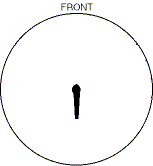
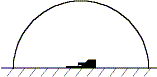
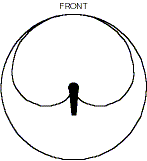
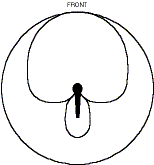
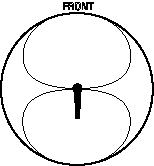
A polar pattern is a graph of a microphone's sensitivity vs. the angle of the incoming sound wave. The farther from center a point on the graph is, the stronger is the mic signal at that angle.
Omnidirectional:
Picks up equally in all directions.
Half-omnidirectional or hemispherical:
Picks up equally over a 180° spherical angle. This is the pickup pattern of PZMs.
All of the following patterns are considered unidirectional because they pick up mainly in one direction.
Cardioid:
“Heart-shaped” pattern that offers maximum rejection (null) at the rear of the microphone.
Supercardioid:
Has a narrower pickup pattern than cardioid, but also has some rear pickup. Note that there are two nulls of maximum sound rejection.
Hypercardioid:
Has a narrower pickup pattern than supercardioid, but also has more rear pickup than supercardioid. Note that there are two nulls.
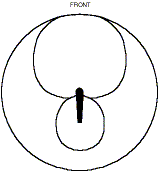
Half-unidirectional:
The pickup pattern of PCC microphones.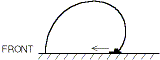
Bidirectional (figure-eight or cosine):
Picks up mainly in two directions (in front of and behind the mic) and rejects sound from the sides.
Traits of Different Polar Patterns
Omnidirectional
- All-around pickup
- Most pickup of room reverberation
- Not much isolation unless you mike close
- Low sensitivity to pops (explosive breath sounds)
- No up-close bass boost (proximity effect)
- Extended low-frequency response in condenser mics. Great for pipe organ or bass drum in an orchestra or symphonic band.
- Lower cost in general
Unidirectional (cardioid, supercardioid, hypercardioid, hemispherical, half-cardioid, half-supercardioid)
- Selective pickup
- Rejection of room acoustics, background noise, and leakage
- Good isolation--good separation between recorded tracks
- Up-close bass boost (except in mics that have holes in the handle)
- Better gain-before-feedback in a sound-reinforcement system
- Coincident or near-coincident stereo miking
- Broad-angle pickup of sources in front of the mic
- Maximum rejection of sound approaching the rear of the mic
Supercardioid
- Maximum difference between front hemisphere and rear hemisphere pickup (good for stage-floor miking)
- More isolation than a cardioid
- Less reverb pickup than a cardioid
Hypercardioid
- Maximum side rejection in a unidirectional mic
- Maximum isolation--maximum rejection of reverberation, leakage, feedback, and background noise
Bidirectional
- Front and rear pickup, with side sounds rejected (for across-table interviews or two-part vocal groups, for example)
- Maximum isolation of an orchestral section when miked overhead
- Blumlein stereo miking (two bidirectional mics crossed at 90 degrees)
Do I Need a Battery Module?
If you want to hear what your Microphone Madness miniature microphone is truly capable of delivering, we recommend an optional battery module (aka: battery box). Microphone Madness battery modules are designed to deliver optimal power to the mics instead of the minimum power that the recorder's bias voltage through the mic input will provide. Simply stated: Optimum Power = Optimum Performance.
In addition, a battery module will further increase the performance and flexibility of your microphone system by:
Increasing the SPL (sound pressure level) handling capability of the microphone
This is particularly advantageous when recording extremely loud sounds, like an amplified rock n' roll concert.
Allowing you the plug your microphone into a "line level" input for recording
Unfortunately, in an effort to reduce cost, size and weight, most mic preamps on portable recorders are poorly designed and can overload easily. By using microphones that are self powered with an internal battery or externally powered though a battery box or phantom power source, you can plug the mic into the line level input, avoiding distortion and usually resulting and a quieter recording with less noise floor. This method of recording is a necessity for some MiniDisc users since many new style recorders do not have a mic sensitivity switch, which allows you to decrease the dBs of the incoming signal.
Battery Module: Bass Roll-Off Filter Option
This is a tricky subject to discuss in general terms since it is largely a matter of personal preference. For most recording applications bass roll-off is not necessary, including voice and acoustic music recording. However, when recording amplified music through a sound system, such as at a live rock concert, more often than not you'll want to use your bass roll-off filter.
There are many factors involved in achieving good sound in the field. It is important to remember that the sound technician for the band is not mixing the PA system for your recording. Instead, he is mixing the sound for the room and the particular style or sound of the band. Often, this involves extremely high levels of low frequency bass in the mix. Room acoustics also play an important role in getting a good recording. Poorly designed or large "cavernous" venues are often "muddy" sounding, no matter how skilled the soundman may be at his craft.
A Microphone Madness battery module equipped with bass roll-off (aka: bass reduction filter) will filter various degrees of bass content from no bass reduction at all to a high degree of bass reduction. *take out{In essence, using bass roll-off when recording amplified music will bring forward the mid-range (guitar / vocals) while keeping the bass notes tight and in control.}
What else should I consider when purchasing a Microphone?
How do you intend to use your microphone?
Do you need it to perform one specialized task or do you require a general purpose microphone? With Microphone Madness, you get hand-crafted, high quality microphones that are easily customizable for your individual needs.
Sound Quality
We guarantee our products will provide exceptional sound quality and overall performance! Your digital MiniDisc or DAT recorder is capable of handling a very wide frequency range... so why not put all of it to use?
Price
Like everything else in audio, microphones range from budget oriented models to ultra high end systems costing $1,000's. Before you start your research, decide what your budget will be for this project and keep it in mind when evaluating specifications and features. Remember to leave some room for a few accessories, like cables and adapters, you'll be sure to need.
Warranty and Service
With Microphone Madness brand microphones, come with a 1 year on parts and labor if you do need to obtain service for any reason, the helpful engineers at Microphone Madness are only a phone call away and ready to service your microphone in a timely fashion.
Microphone Specifications
Frequency Response
The measure of the consistency with which it translates a given sound pressure level into a given audio signal level at different frequencies.
Polar Response / Polar Pattern / Pickup Pattern
The way in which the element responds to sounds coming in from different directions. The several different kinds of patterns include omnidirectional, cardioid, hypercardioid & figure eight.
Sensitivity
A measure of the output level at a specific SPL level.
Maximum SPL
The maximum SPL a microphone will accept before distorting.
Impedance
The equivalent total AC resistance to current flow that would be "seen" looking into the microphone’s output. Ideally, a microphone should be connected to a load whose input impedance is roughly ten times the mic’s source, or output impedance.
Microphone Types
Dynamic
Works like a loudspeaker; a diaphragm is coupled to a coil of fine wire. The coil is mounted in the air gap of a magnet, free to move about within the gap. As the diaphragm moves in response to acoustical energy, the coil moves within the magnetic field, thereby inducing a small electrical current.
Condenser
A gold plated plastic diaphragm, mounted above a conductive back plate, separated by a small volume of air, form an electrical component called a capacitor. A polarizing voltage (called phantom power) is applied to the diaphragm by an external power supply, charging it with a fixed, static voltage. As the diaphragm vibrates in response to acoustic energy, it moves closer to and farther from the back plate. As it does, the electrical charge that it induces in the back plate changes proportionally, and produces an electrical representation of the diaphragm.
Electret Condenser
Electrets are unique in that the diaphragms are permanently charged in the manufacturing process and retain a static charge indefinitely, thereby requiring no external polarizing voltage. Electrets still require external power (phantom power or an internal battery) for the internal amplifier that is necessary to buffer the high impedance condenser capsule output from the relatively lower impedance of the mic input.
Ribbon
Ribbons employ a transducer system similar to the dynamic microphone, but the diaphragm, a thin, corrugated metal ribbon, is stretched within the air gap of a powerful magnet.
Other Useful Terms
Unbalanced Connection
This is a two-wire system: one wire carries the audio signal, and the other (called the shield) is connected to ground, or the electrical reference point.
Balanced Connection
A three-wire system: two separate wires carry the signal – one inverted in polarity with respect to the other – and the third is the shield, which again is connected to ground. Balanced connections are almost always used for low – impedance microphones. The balanced system is more immune to noise.
Proximity Effect
An increase in low frequency response when a microphone is very close to a sound source. It is an inherent characteristic of directional microphones.
Bass Roll – Off / Low cut filter
Trims down, or "rolls – off" the low frequency response of a microphone.
Phantom Power
A system for providing a polarizing voltage for condenser microphones that is sent down the mic line. Most consoles today will generate phantom power.
Mic Pad
Usually a switch on the mic or on a console input that would effectively reduce the output of a mic by a predetermined amount, usually 10dB. Mic pads are used to avoid overloading mic preamps with high output mic signals.
 We accept purchase orders from the following: School, Hospital, Federal, State, County & City Government